
“`html
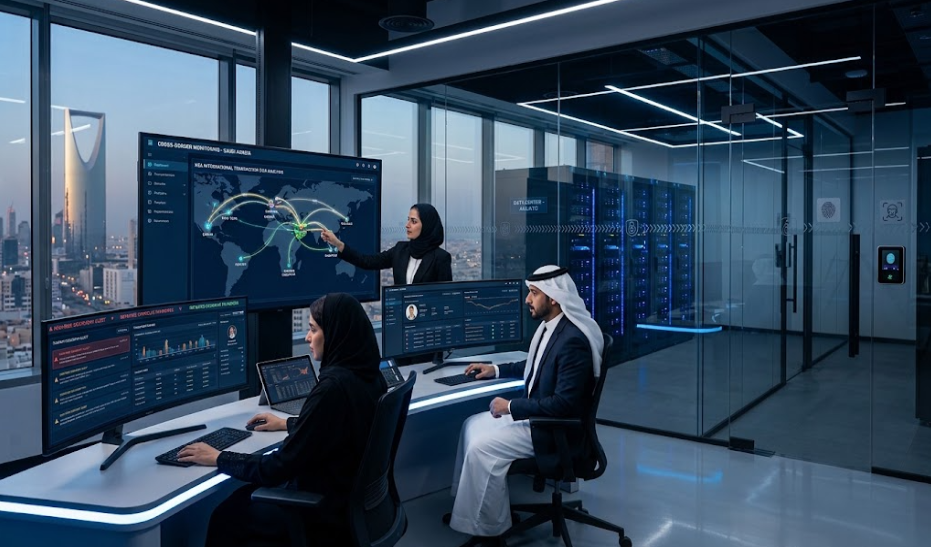
Cross-Border Financial Crime Risks:Strengthening International Transaction Monitoring in Saudi Arabia
Saudi Arabia’s position as a major regional economic hub has resulted in significant growth in international trade, investment, remittances, and cross-border financial activity. Banks, fintech companies, payment providers, and other financial institutions process substantial volumes of international transactions every day.
While cross-border financial activity supports economic growth, it can also increase exposure to money laundering and other financial crime risks. Criminal networks may use multiple jurisdictions, accounts, intermediaries, and payment channels to make the movement of illicit funds more difficult to identify.
For Saudi financial institutions, effective cross-border AML compliance requires stronger transaction monitoring combined with geographic, customer, and counterparty risk assessment.
Identifying Geographic Risk
Geographic exposure is an important element of international transaction risk. Financial institutions should evaluate the jurisdictions involved in transactions and consider factors such as financial crime risk, sanctions exposure, regulatory transparency, and the customer’s legitimate business relationship with the destination.
A transaction involving an international jurisdiction is not automatically suspicious. However, unusual activity that has no clear economic or commercial purpose may require additional investigation.
Monitoring International Transaction Patterns
Cross-border monitoring should focus on patterns rather than individual transactions. Examples of potentially unusual behavior include repeated transfers to unrelated overseas accounts, sudden increases in international payment volumes, rapid movement of funds between several jurisdictions, and transactions inconsistent with the customer’s historical activity.
Behavioral monitoring can help institutions identify these changes more effectively.
For example, if a customer historically conducts domestic transactions but suddenly begins making frequent high-value transfers to multiple overseas entities, the activity could trigger a risk-based review.
Strengthening Customer Due Diligence
Customer Due Diligence is particularly important when managing international financial relationships. Institutions should understand the customer’s business model, expected transaction activity, source of funds, counterparties, and geographic exposure.
Beneficial ownership verification is also essential when dealing with corporate customers. Understanding who ultimately owns or controls an entity can help financial institutions identify hidden relationships and reduce exposure to opaque corporate structures.
Technology-Driven Cross-Border Monitoring
Technology can significantly improve international transaction monitoring. Automated screening systems can evaluate transactions against sanctions and PEP databases, while AI and behavioral analytics can identify unusual patterns across large datasets.
Automated systems can also help compliance teams prioritize investigations based on risk levels rather than manually reviewing every transaction.
Maintaining comprehensive digital records is equally important. Institutions should be able to demonstrate how international transactions were monitored, how alerts were investigated, and why compliance decisions were made.

As Saudi Arabia’s international financial activity continues to grow, cross-border AML monitoring will remain an important component of financial crime prevention. Financial institutions that combine geographic risk assessment, continuous transaction monitoring, customer due diligence, sanctions screening, and intelligent analytics can strengthen their ability to identify emerging threats. FACEKI AML Service, based in Riyadh, Saudi Arabia, is an approved AML provider that helps organizations strengthen identity verification, customer due diligence, transaction monitoring, sanctions screening, and risk management while supporting compliance with SAMA, CMA, and IA regulations in KSA.
